









An owner has a floor of underutilized office space and keeps hearing that coworking is in demand. They pull together some industry numbers, talk to a broker, and start pricing out a buildout. Somewhere between the first contractor quote and the pro forma, they realize something uncomfortable: they have no idea whether the people who actually work near this building would pay for this product, or whether enough of them even exist.
This is not an information problem. It is a question problem.
The question "is coworking profitable?" is unanswerable at the category level, and owners who treat it as a category question end up making capital decisions on logic that cannot support them.
The Wrong Question
Projections put the coworking market on a path from $50 billion to $200 billion by 2034.[1] Flexible workspace models keep expanding, and the broader category is forecast to grow significantly through the end of the decade.[2] None of this tells you whether your 8,000-square-foot third floor in a secondary metro will attract enough paying members to cover its cost structure.
That is the gap. Industry data says coworking works. But industry data describes averages across thousands of locations with wildly different assets, markets, pricing models, and competitive sets. Averages are what you get when profitable spaces and failed ones share a dataset.
Owners reach for category-level validation because it feels like due diligence. They find a growth chart, a market size number, a stat about remote work adoption, and build a story around it. But the story skips the only chapter that matters: whether this specific building, in this specific trade area, can attract the specific density of paying users the financial model requires.
Industry data tells you coworking can work. It tells you nothing about whether it will work here.
Coworking profitability is always a local product-market fit problem. What owners should be asking is not whether the category is viable. What matters is whether enough demonstrable demand exists within a tight radius of their asset to sustain the utilization rates the model needs to clear its cost structure.
That question cannot be answered by a broker conversation or a market report built for investors. It requires a different kind of analysis.
How to Evaluate Demand Before You Build: Three Tests Before Any Capital Decision
Rather than asking whether coworking is profitable, owners should run a three-part asset-fit test. Each test addresses a different failure mode. All three need to clear for the conversion to hold up.
Test 1: Does local demand exist at the density this model requires?
Coworking is a volume business at the desk level and a retention business at the office level. Both require a deep enough pool of potential members within a realistic commute radius - shaped by local employment composition, business formation rates, remote work penetration, and the presence of freelancers, small firms, and distributed teams.
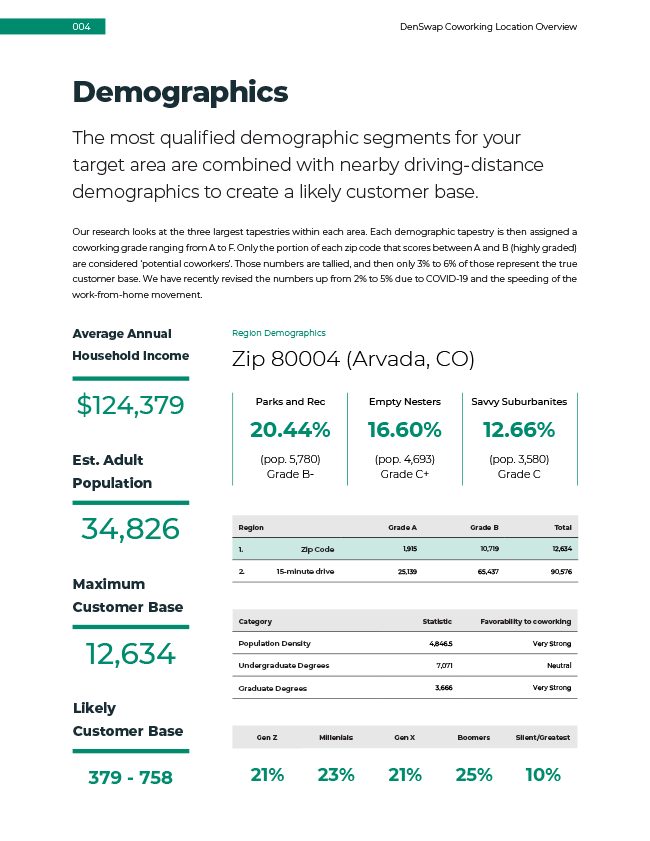
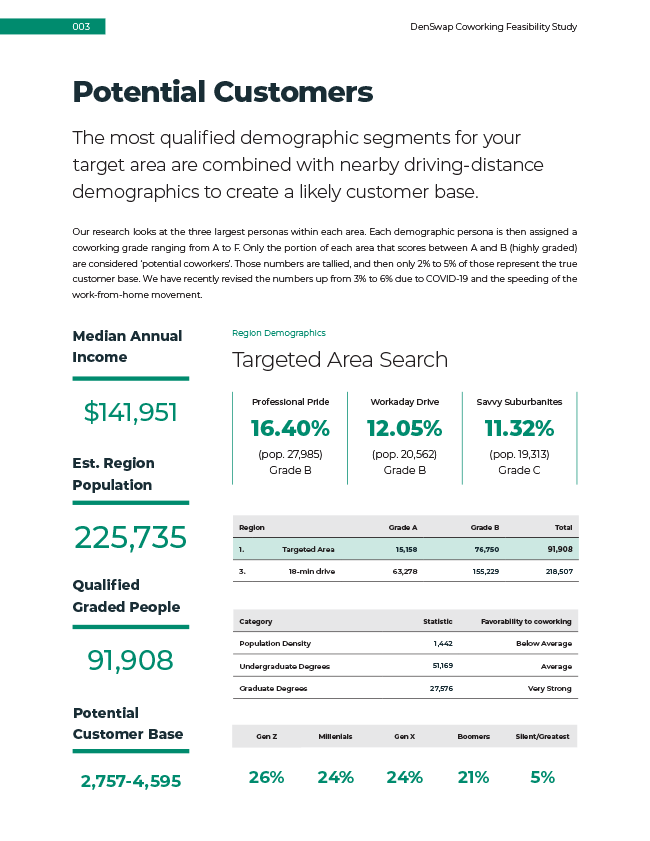
Asking whether people work near the building misses the point. What matters is whether enough of the right workers, at the right price sensitivity, exist in close enough proximity to fill your space consistently. Office vacancy in your metro does not answer this.[3] Demand data at the trade-area level is what you need, not MSA-wide figures that smooth over the very local dynamics that determine whether a specific building fills or doesn't.
Test 2: Does the asset support the member experience the market expects?
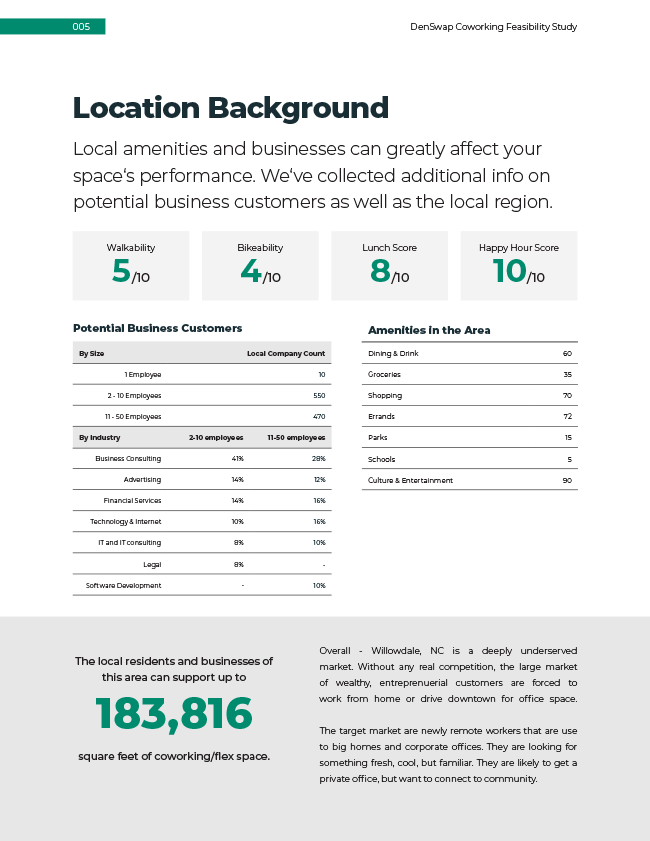
Not every underperforming office floor converts well. Floor plate depth, ceiling height, natural light access, elevator capacity, lobby condition, parking ratios, and building systems all shape the member experience a coworking space can deliver.[4] A building that works fine for a single-tenant lease may fail completely as a flexible workspace because the experience expectations are categorically different.
Members compare your space to every other workspace option available to them, including their home office. If the asset cannot deliver the environment the local market expects at the price point the market will bear, utilization stays shallow regardless of how strong the demand signal looks on paper.
Test 3: Does local pricing support the margin the buildout creates?
Buildout costs create a fixed cost base that needs to be covered by recurring revenue at achievable occupancy rates. Critically, the pricing you can charge is set by your local competitive environment, not by your cost structure.
This is where many conversion pro formas break. Owners back into pricing from their buildout costs and assume the market will meet them. But pricing is a market output, not an owner input. If comparable flex spaces in the trade area are priced at $350 per desk and your cost structure requires $500, no amount of design quality closes that gap.
The pricing you can charge is set by your competitive environment, not by your buildout budget.
All three tests work together, and no single strong result carries the others. Strong demand with a poor asset fails. A great asset in a thin market fails. A perfect match of demand and asset in a pricing environment that cannot support the cost structure also fails. All three need to hold.
The Decision Window That Matters Most
Leverage in any coworking conversion sits in the period before buildout commitments. Once construction starts, the capital is deployed and the decision is largely irreversible. Before that point, every option is still open: redesign the concept, adjust the scale, reposition the asset for a different use, or walk away entirely.
Owners who test demand and asset-concept alignment during this window make better decisions because they still have room to adjust. Owners who skip this step and move straight from industry enthusiasm to contractor bids are betting that category-level logic will hold at the site level. Sometimes it does. Often enough, it does not.
With office fundamentals still in flux across many metros[5] and transaction volumes reflecting ongoing uncertainty[6], the cost of a misread on local flex demand is higher than it was five years ago. Capital deployed into a conversion that underperforms is capital that cannot be redeployed quickly.
Running the three tests requires data that most owners do not have on hand: trade-area demand modeling, competitive pricing analysis, asset configuration assessment against flex workspace requirements, and revenue projections built from local inputs rather than industry averages.
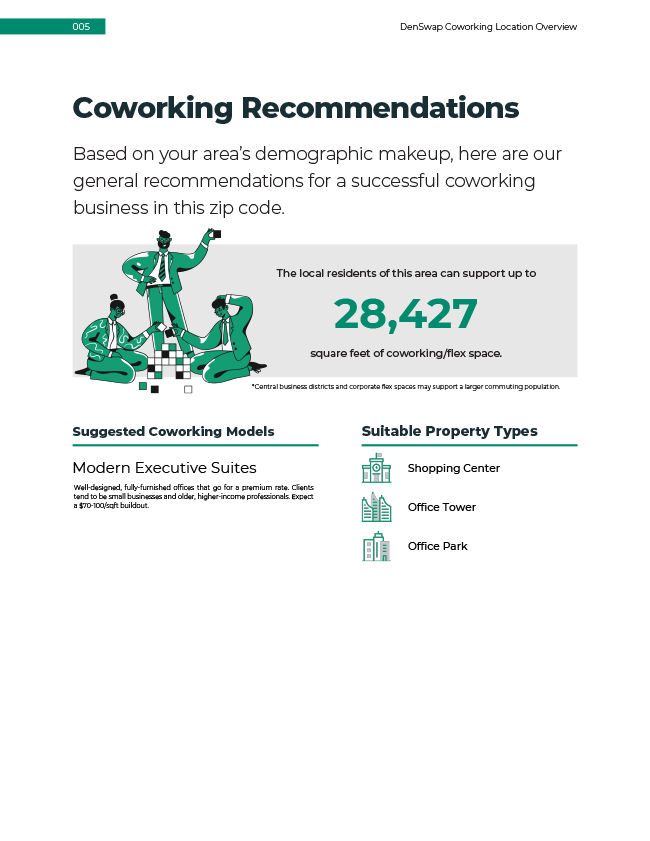
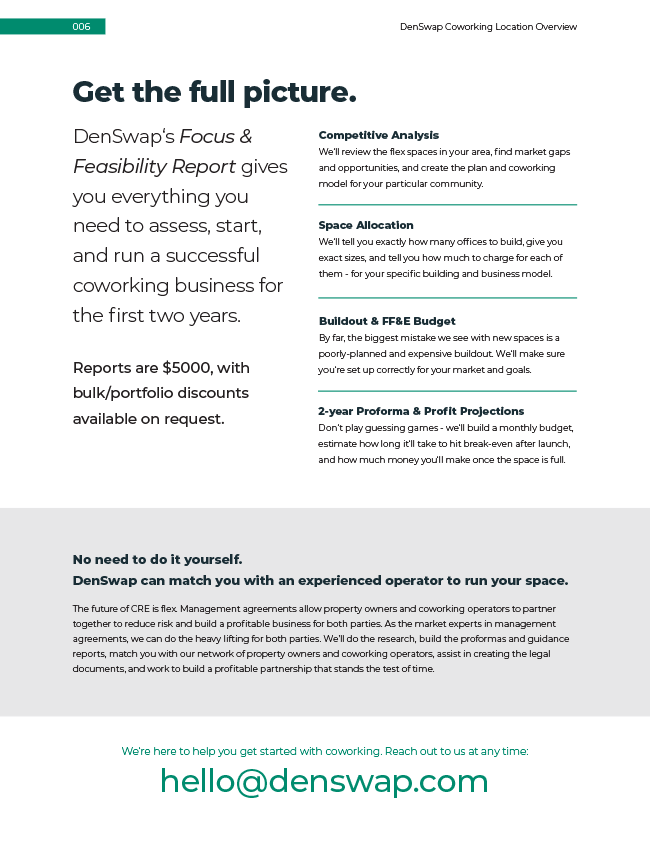
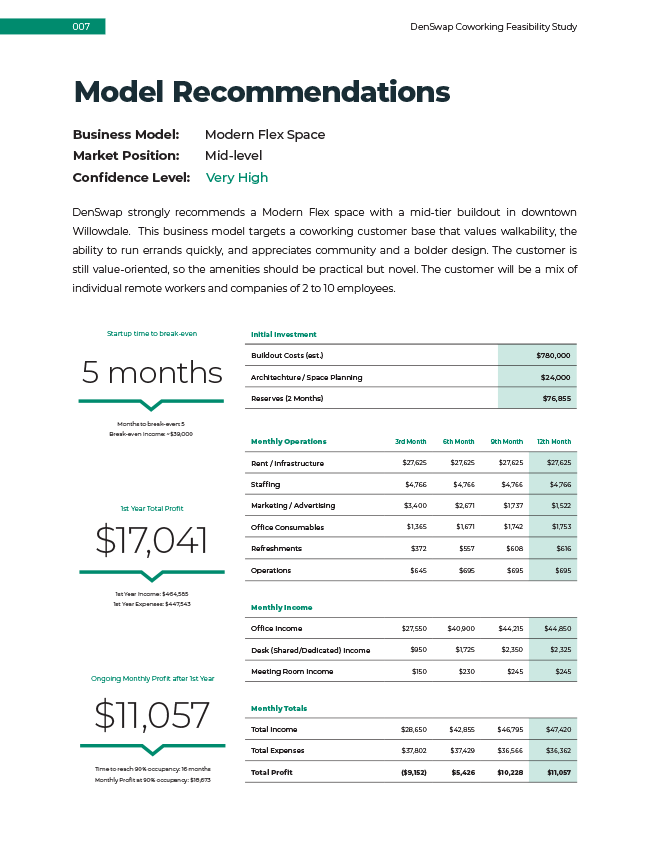
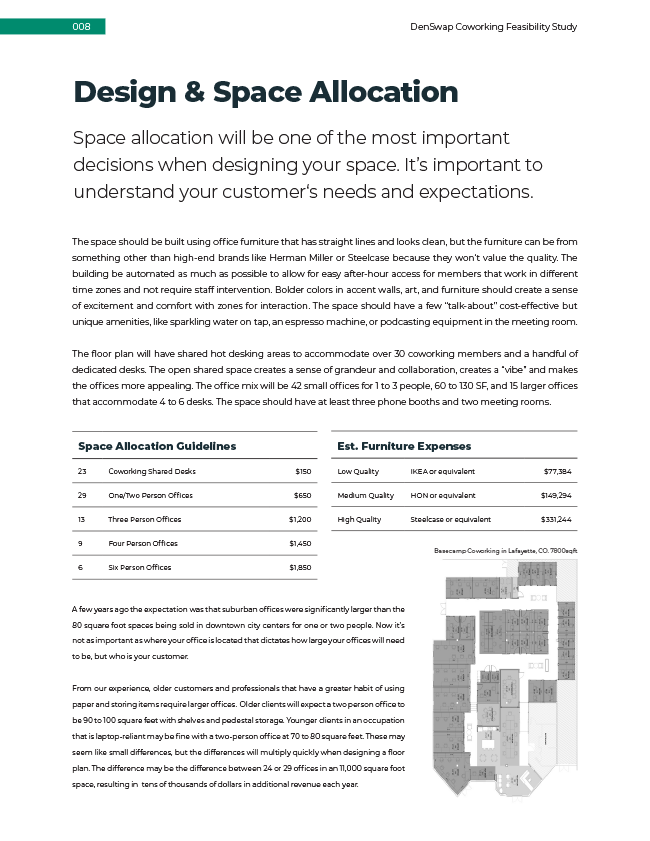
That is exactly what a DenSwap feasibility study is built to deliver. It tests whether your specific asset, market, and concept align before you spend on design and construction. The output includes demand and demographic analysis, competitive positioning, revenue and expense projections, space allocation, pricing strategy, buildout budgeting, and a two-year proforma modeled to your actual building. You can download a sample to see the depth of analysis before committing.
Owners who run this analysis before breaking ground are not just buying data. They are buying the option to change course while changing course is still cheap. That optionality is worth more than any market report, and it only exists on one side of the construction contract.